
WEED GUIDE
How to identify and control horsetail
Deep brittle roots make it persistent, especially on compact or damp ground. Learn how to identify it, choose the right control method and prevent it returning.
13 sections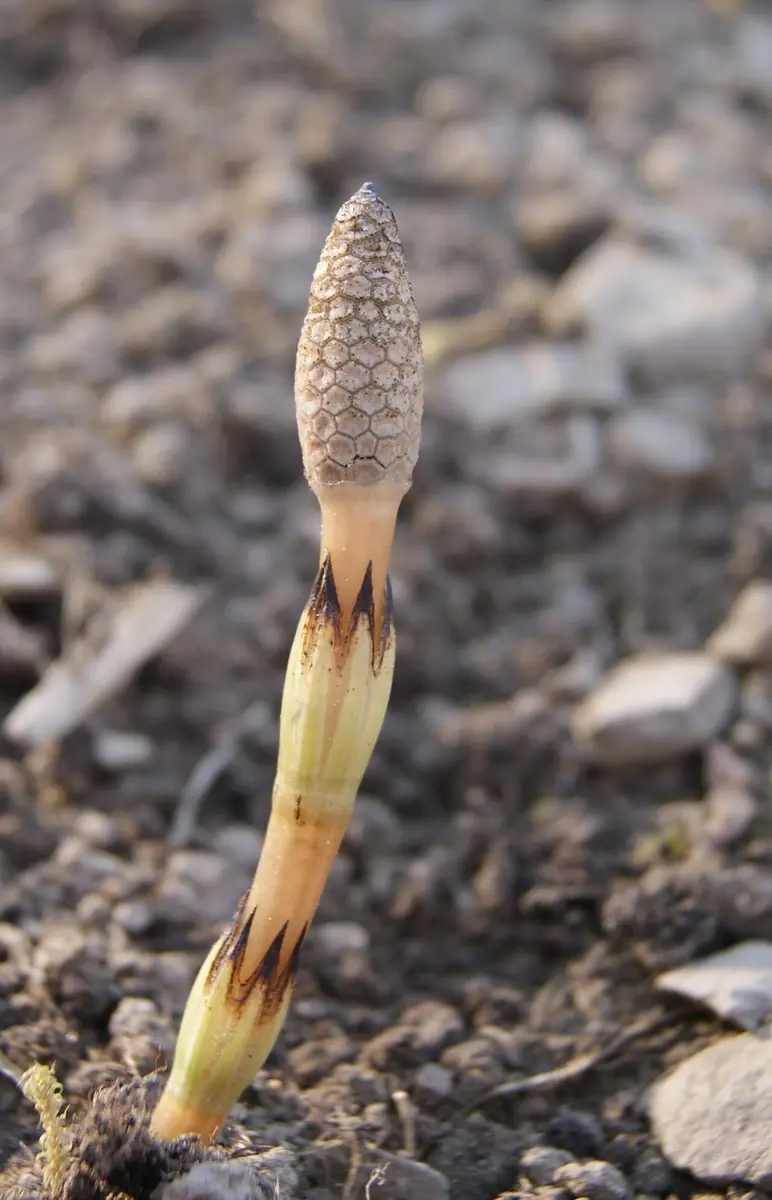
Identification
The plant has two very different shoots: pale, cone-bearing spore stems in early spring and green, jointed, brush-like stems later. The green shoots have whorls of fine branches and a rough, ridged surface; confusing it with a simple grass leads to poor control.
Deep brittle roots make it persistent, especially on compact or damp ground. Its main route of spread is deep rhizomes and spores. Check the crown and roots as well as the leaves: those features help distinguish a seedling that can be hoed from a plant that will need follow-up.
UK seasonality and timing
Repeated removal from spring through summer gradually weakens it.
Horsetail persists as a perennial through deep rhizomes and spores. The foliage is easy to cut back, but roots must be weakened or removed and new shoots checked through the season.
Crops and plants affected
Horsetail is not a crop parasite. It affects vegetables and flowers where it competes for space, light and water or obstructs access to beds. Deep brittle roots make it persistent, especially on compact or damp ground. Give priority to seedlings, newly transplanted crops and plants sharing the same small bed; a separated patch is less urgent if it cannot spread into cultivated ground.
What damage does it cause?
Deep brittle roots make it persistent, especially on compact or damp ground. The impact depends on how densely it grows and how close it is to a crop. A few plants outside the bed rarely justify disturbing a whole plot; growth among seedlings or over crop foliage is more likely to reduce establishment and make harvesting difficult.
For horsetail, persistence comes from deep rhizomes and spores. Removing leaves without addressing that route clears the surface briefly but leaves the source of another flush in place.
Prevention
Improve drainage where possible and remove shoots repeatedly. Do this before the plant spreads further, and clean soil from tools before moving to an uninfested bed. Keep bed edges visible so new shoots or seedlings are spotted early.
Where horsetail is too extensive to dig in one visit, exclude light with a secure cover; its deep rhizomes and spores means the edges need repeat checks.
Control and management
- Improve drainage where possible and remove shoots repeatedly.
- Cover ground while clearing nearby beds by hand.
- Repeated removal from spring through summer gradually weakens it.
Wildlife-friendly and soil-conscious control
For horsetail, use a low-disturbance method suited to its growth: Improve drainage where possible and remove shoots repeatedly. Work only the affected patch, check before disturbing wildlife shelter and avoid salt, household vinegar or washing-up liquid, which can damage soil and nearby plants.
Cover ground while clearing nearby beds by hand.
Long-term management
Cover ground while clearing nearby beds by hand. Repeat inspections through active growth. Mark the edge of the patch and remove new shoots before they replenish the root system; do not assume one cleared visit has finished the job.
Common mistakes
Do not expect one digging session to remove every deep rhizome.
Do not compost rhizomes or mature spore bearing stems.
If it keeps returning
If the same patch reappears, check below the point where the leaves emerge. For a perennial weed, the next useful step is cover ground while clearing nearby beds by hand. Repeat at the timing described above rather than repeatedly cutting the visible leaves alone.
If horsetail appears in a neighbouring bed, trace whether the route is deep rhizomes and spores and contain that edge first. Avoid carrying contaminated roots or seed heads across the plot.
Frequently asked questions
Does cutting horsetail shoots kill its deep roots?
The plant has two very different shoots: pale, cone-bearing spore stems in early spring and green, jointed, brush-like stems later. The green shoots have whorls of fine branches and a rough, ridged surface; confusing it with a simple grass leads to poor control. Improve drainage where possible and remove shoots repeatedly. Expect to repeat the work as new shoots appear.
When should I tackle horsetail?
Repeated removal from spring through summer gradually weakens it.
Can I compost horsetail?
Do not compost rhizomes or mature spore bearing stems.
Why can horsetail keep coming back?
It spreads by deep rhizomes and spores. Small living root sections may produce fresh shoots, so check the patch again during active growth.